Most trouble on a river is not the rapids. It is the things you cannot see from the bank.
Submerged branches and jammed trees are more dangerous than any wave, because the water passes through them and a person does not. Concrete remains of old weirs form holes that hold. Low water exposes rock that was harmless when the level was up.
Why a tree is more dangerous than a rapid
A rapid is powerful, but it lets things through. Water hitting a wave passes through it and spits out whatever it carries. A jammed tree does the opposite: the water passes through the branches, and the boat and the person stay pinned against it by the force of the whole flow.
You recognise it because the water around it makes no noise and no foam — it looks calm, and that is the worst possible signal. The rule is that wood in the water is avoided at distance, and upstream, while you still have control of your direction.
If the boat does end up against an obstacle, the only correct move is to lean into it, not away. Leaning away rolls the hull under the water, and that is where the real problem begins. It goes against every instinct, which is why it is practised somewhere calm, in advance.
Holes, weirs and places that hold
The concrete remains of old weirs are the most treacherous thing on a gentle river, because they look like a small step. Water falling over a straight edge falls uniformly and forms a hole that recirculates across the whole width — without a single point where anything could get out.
A natural rapid almost always has an exit. A man-made weir as a rule has none, which is exactly why it is not run even at low water. You carry the boat along the bank, however excessive that looks.
If someone is caught in a hole, the way out is down and forward — the current beneath the hole carries on downstream. Tucking up and letting the water take you deeper is the only reliable way out, and it too goes against instinct.
Rules that allow no exception
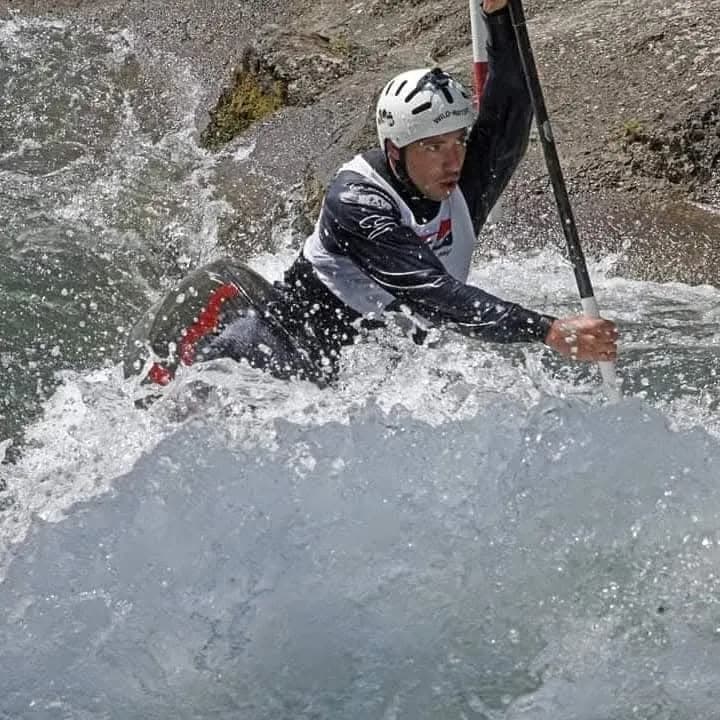
A practical rule that holds everywhere: never alone, always within sight of someone, and always with a vest and helmet even on a stretch you know by heart.
With them go three things carried on the body, not in the boat: a whistle, a line knife, and a throw bag if you are in a group. Whatever is in the boat stops being yours the moment you capsize.
And one rule about the group: you travel in order, with someone who knows the section first and the most experienced last. Spacing close enough to see the one behind. Nobody stops where the one behind cannot see them in time.
Kit: the failures are mundane
As for kit, the usual failures are mundane — a snapped rudder pedal, a leaking bulkhead, a worn cockpit rim seal. Repair tape, a spare clip and half an hour before launch solve ninety per cent of it.
The pre-launch check is the same every time: seat and footrests tight, bulkheads dry, rudder moving without catching, vest buckles holding, helmet adjusted so it does not slip over the eyes. Two minutes.
Afterwards the boat is emptied, opened and left to dry. Moisture sealed inside a bulkhead works away for months and turns a small crack into a large one. It is the same reason repair tape lives in the bag and not at home.
What is still to be published
The race safety plan, the positions of rescue teams and the capsize procedure will form part of the official regulations.
Until then, what applies on any river applies here: the judgement is made on site, on the day you go, and always in favour of the more cautious option.